

Find a Commercial Window Supplier That Fits Your Project
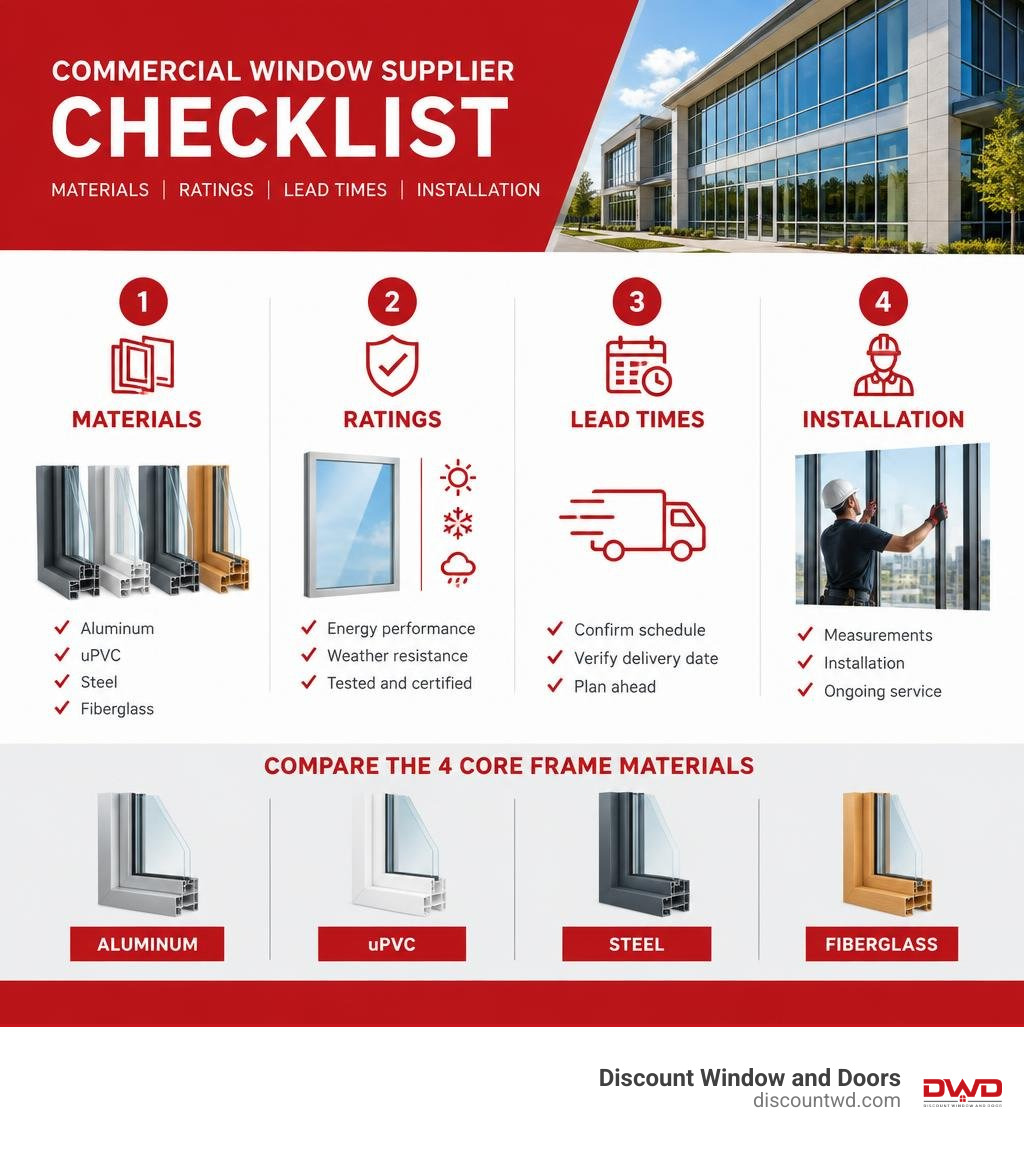
Start with suppliers that can meet your window schedule and delivery date. Ask each one for frame and glass specifications, tested energy and weather ratings, and a written lead time for your exact order. Compare aluminum, uPVC, steel, and fiberglass options against your building’s needs. Then confirm who handles measurements, installation, and service if something goes wrong.
A low quote is less useful if the windows arrive late or fail to meet the plans. Put product quality, lead time, and scope of work side by side before you choose.
I’m Walker Troy Jenkins, and I’ve worked in building materials and window installation for more than 25 years. As a licensed glazing contractor, I know what to check when choosing a commercial window supplier; next, we’ll compare the materials and lead times that shape that choice.
Comparing Window Frame Materials for Commercial Projects
Selecting the proper frame material shapes everything from structural span capacities and facade aesthetics to heating and cooling loads. Every material presents distinct engineering strengths, maintenance profiles, and fabrication lead times that impact overall construction schedules.
When planning commercial fenestration, architects, general contractors, and developers typically choose between four core frame materials: architectural aluminum, commercial-grade uPVC, structural steel, and high-performance fiberglass.
| Frame Material | Thermal Efficiency | Structural Durability & Strength | Maintenance Needs | Typical Fabrication Lead Times | Best Architectural Applications |
|---|---|---|---|---|---|
| Architectural Aluminum (Thermally Broken) | Moderate to High (with thermal struts) | Very High; excellent strength-to-weight ratio for large glass expanses | Low; factory-applied powder coat or anodized finishes resist corrosion | Standard: 6–12 weeks; Custom: 14–18 weeks | Commercial storefronts, mid-to-high-rise envelopes, educational facilities |
| Commercial uPVC (Multi-Chambered) | High to Superior; multi-chambered internal profiles trap air | Moderate; requires internal steel reinforcing for larger spans | Very Low; lead-free, non-corrosive, no repainting needed | Standard: 4–8 weeks; Custom: 8–12 weeks | Multi-family housing developments, modular commercial units, social housing |
| Structural Steel | Low to Moderate (modern profiles feature thermal breaks) | Exceptional; unmatched tensile strength allows ultra-slim sightlines | Low to Moderate; requires hot-dip galvanizing and factory coatings | Standard: 12–16 weeks; Custom: 18–26+ weeks | Historic replications, luxury retail, boutique hospitality, industrial-chic interiors |
| Commercial Fiberglass | Superior; natural insulator with up to R-10 performance | High; expands 800% less than vinyl for structural dimensional stability | Low; rot-proof, warp-free, resists coastal salt spray | Standard: 8–14 weeks; Custom: 14–20 weeks | Net-zero builds, Passive House certifications, harsh coastal commercial zones |
Explore our comprehensive selection of commercial windows to evaluate how each profile integrates into structural plans.
How to Choose a Commercial Window Supplier by Frame Performance
Frame engineering dictates how well an entire fenestration package manages exterior climate conditions over decades of building occupancy. Evaluating suppliers requires looking past aesthetic mockups to analyze core performance metrics:
- U-Factor Metrics: The U-factor measures the rate of non-solar heat transfer through the window assembly. Lower numbers indicate superior insulation. High-performance commercial fixed systems target U-factors around 0.34 or lower, while operable project-out casements typically achieve 0.43 depending on glass makeups.
- Solar Heat Gain Coefficient (SHGC): This measures how much solar radiation enters through the glass and frame. In cooling-dominated regions, low SHGC ratings (0.20 to 0.28) drastically lower peak air-conditioning demands.
- Air Infiltration CFM Ratings: Air leakage degrades building envelope efficiency. Premium commercial assemblies achieve air infiltration rates as low as 0.01 to 0.06 cubic feet per minute (CFM) per square foot under strict pressure testing (such as 6.2 psf).
- Condensation Resistance (CR): Condensation leads to interior moisture collection, degradation of surrounding drywall, and mold growth. Thermally insulated frames keep interior frame surfaces warm, preventing interior air moisture from condensing against the metal.
High-performance fiberglass systems demonstrate how modern composite materials achieve exceptional thermal ratings up to R-10, pairing thin-glass technology with low air leakage.
Thermal Strut Aluminum vs. Non-Thermally Broken Systems
Standard aluminum is an exceptional conductor of thermal energy. In uninsulated frames, outdoor temperatures travel freely inside, causing high HVAC energy losses and continuous condensation along interior window sills.
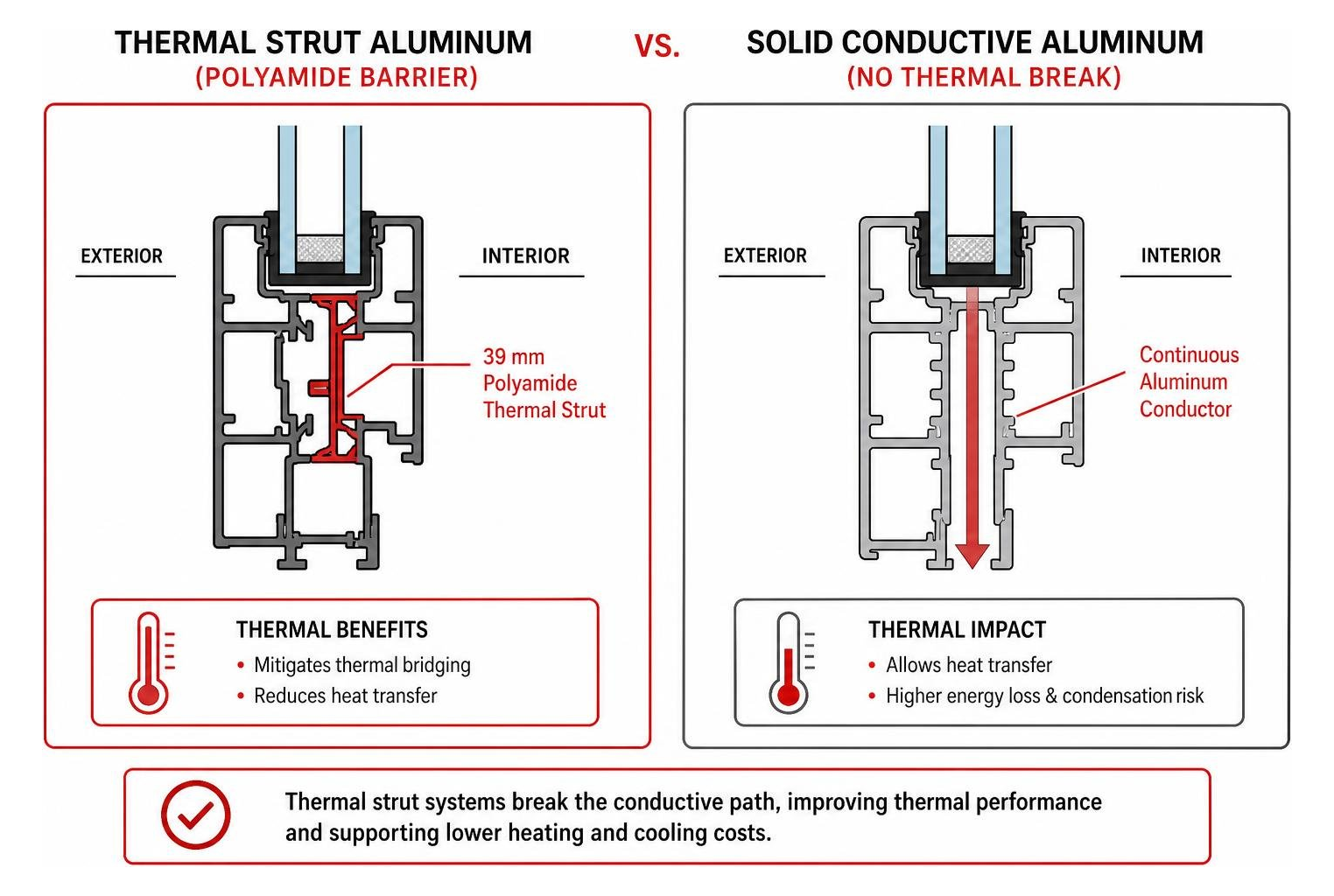
Modern architectural systems resolve this with a structural thermal break. High-performance models incorporate a 39 mm polyamide thermal strut inserted between the interior and exterior aluminum extrusions. Polyamide acts as an insulator, breaking the conductive path.
Key benefits of thermal strut systems include:
- Mitigating Thermal Bridging: Significantly reduces heat transfer across the building envelope.
- Lowering Operating Costs: Keeps heating and cooling loads manageable, satisfying modern energy codes.
- Preventing Surface Moisture: Keeps interior aluminum surfaces warm, preventing condensation even during high indoor humidity.
For applications requiring structural strength alongside thermal insulation, our architectural-grade All Weather Aluminum Windows combine deep polyamide barriers with tested AW-PG architectural performance grades.
How to Evaluate a Commercial Window Supplier for Large-Scale Builds
Managing large-scale commercial projects requires coordination between fabricators, logistics managers, and project superintendents. Evaluating potential partners involves checking operational stability, wholesale network access, and warranty frameworks.
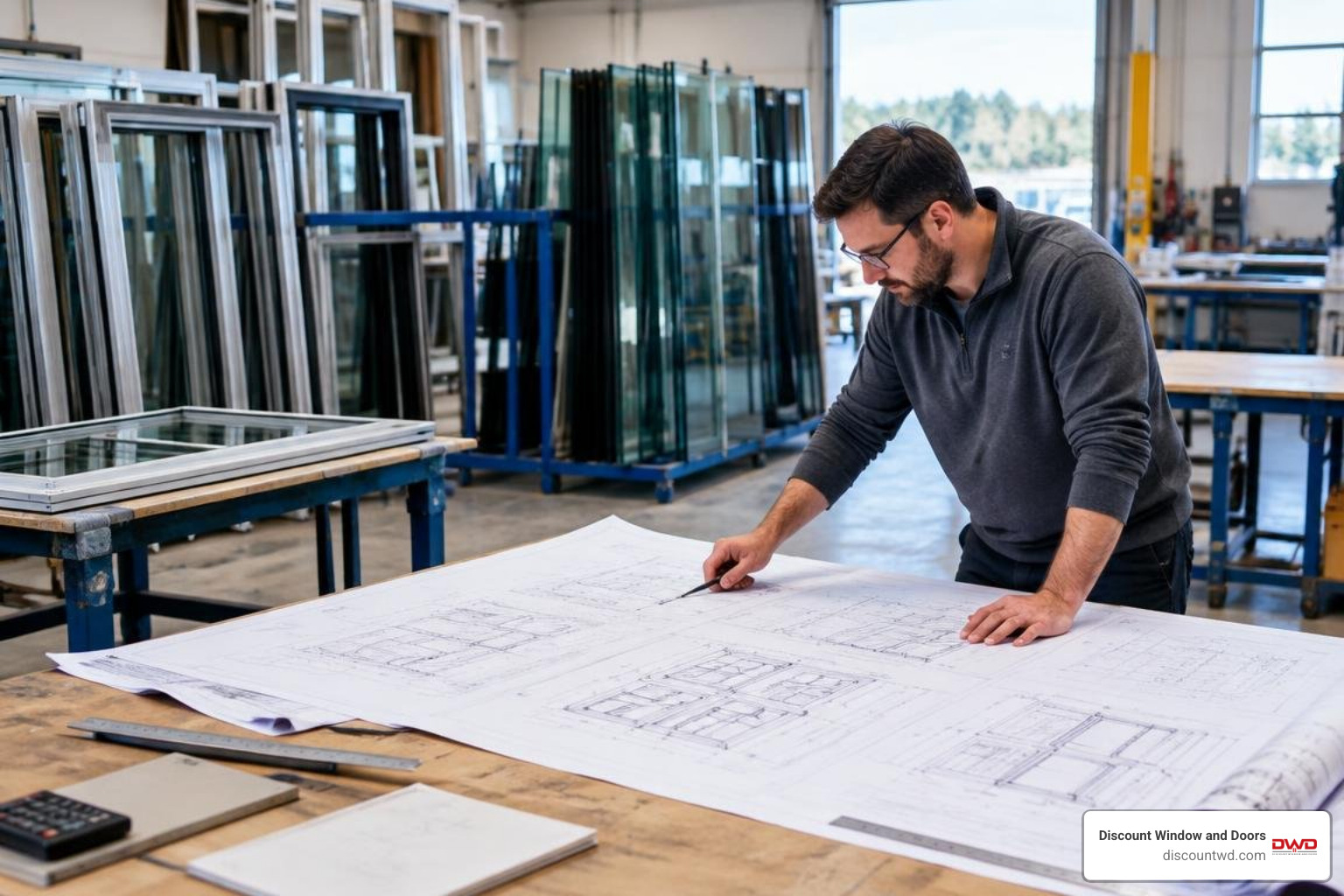
Material pricing volatility presents a challenge on multi-phase builds. When a project spans 12 to 24 months from architectural sign-off to final glazing, unprotected material bids can face unexpected price spikes. Established suppliers protect commercial clients by offering 12-month fixed pricing agreements. Locking in material costs stabilizes project pro-formas, guarantees bid accuracy for general contractors, and ensures predictable capital allocation.
To streamline bidding and material scheduling for your next build, Request a Quote or Apply for Account to access commercial wholesale purchasing channels.
Supplier Services: Design, Manufacturing, and Regional Installation
A dependable fenestration partner serves as an integrated project consultant rather than a simple order desk. Look for comprehensive service capabilities across every phase of the project:
- Early-Stage Technical Support: Providing downloadable CAD files, BIM models, and custom extrusion detailing ensures seamless architectural plan integration before submittals.
- Transparent Fabrication Channels: Direct relationships with major extrusion mills and glass fabricators give transparency into manufacturing schedules, eliminating unexpected supply chain delays.
- Regional Installation Teams: While national brokers outsource field labor to third-party sub-crews, working with dedicated regional specialists ensures proper envelope flashing, structural anchoring, and sealant application.
- Turnkey Glazing Coordination: Integrating overhead daylights and custom canopies alongside standard fenestration prevents coordination gaps, providing complete building daylighting integration under single-point accountability.
Discover how our turnkey field crews manage commercial openings from preliminary framing rough-ins to final envelope inspections through our Professional Installation services.
Essential Certifications to Demand from Your Commercial Window Supplier
Commercial building codes require rigorous independent testing. Verify that prospective suppliers hold current documentation for these vital quality standards:
- AAMA / FGIA AW-PG Ratings: The Architectural Window (AW) performance class represents the highest commercial standard for structural load, water intrusion, and air infiltration. Ratings such as AW-PG80 or AW-PG100 verify that the window withstands severe wind pressures (up to 120–150 psf structural test loads) without frame failure or water penetration at high test pressures (15 psf).
- NFRC Certification: National Fenestration Rating Council labels certify real-world U-factor, SHGC, and Visible Transmittance ratings across the complete frame-and-glass assembly.
- ISO 9001 & Environmental Compliance: ISO 9001:2015 manufacturing certifications confirm strict quality control protocols across production runs. Frame profiles meeting lead-free, non-toxic environmental guidelines contribute toward LEED and green building certifications.
- Enhanced Security Standards: Window packages featuring multi-point locking systems, laminated impact glass, and security accreditations (such as Secured by Design standards) provide robust forced-entry resistance for public sector, multi-family, and ground-floor retail builds.
Commercial Window Configurations and Architectural Applications
Commercial facades require varied opening types to address occupant safety, building ventilation, accessibility codes, and regular maintenance requirements.

- Projected & Architectural Casements: Outswing and project-out awning styles direct breezes inward while shedding exterior rainfall. Modern multi-point hardware creates a compression seal around the perimeter, delivering high weather resistance.
- Flush Tilt-and-Turn Systems: Common in European engineering and increasingly popular across North American commercial builds, tilt-and-turn units offer dual functionality: tilting inward from the top for secure, draft-free ventilation, or swinging inward like a side-hung door for easy interior cleaning.
- 180-Degree Fully Reversible Windows: Reversible sashes rotate 180 degrees completely outside the building envelope without disturbing interior window treatments or furniture. This design allows maintenance crews to clean exterior glass panes from inside the building, lowering maintenance costs on multi-story housing developments.
- Fixed Vision Glass & Storefront Systems: Maximizing natural daylighting, fixed units utilize narrow sightline frames capable of supporting heavy double- and triple-glazed units, spanning tall structural openings in retail and office environments.
To maintain visual harmony across the entire exterior facade, coordinate your commercial window schedules alongside matching entrance systems. Browse our commercial Doors and architectural All Weather Aluminum Doors to integrate storefront entries, multi-slide egresses, and panic-hardware-ready portals.
Frequently Asked Questions About Commercial Windows
What are the key performance metrics to consider for commercial windows?
The primary metrics to evaluate include:
- U-Factor: Measures thermal conductivity across the frame and glass; lower values (such as 0.28 to 0.34) reflect superior insulation.
- Design Pressure (DP / AW-PG Ratings): Identifies the maximum wind load and structural forces the assembly can handle without permanent deformation.
- Water Penetration Resistance: Tested in pounds per square foot (psf); verifies that driving rain will not penetrate the frame under elevated wind pressures.
- Air Infiltration (CFM): Assesses air leakage per square foot of window area; tight building envelopes require ratings below 0.05 CFM/sq ft.
- Sound Transmission Class (STC) & OITC: Indicates acoustic attenuation capabilities, essential for commercial hotels, multi-family housing, and urban offices located near traffic or industrial corridors.
How does fixed pricing benefit commercial window procurement?
Fixed-price agreements guarantee window and door package costs for a specified period (such as 12 months), protecting developers and contractors against raw material price spikes in aluminum, resin, and float glass. This stability ensures accurate budgeting, prevents change orders, and simplifies long-term cash flow management across extended commercial construction schedules.
How do commercial windows improve building sustainability?
Modern commercial windows contribute to sustainability through several mechanisms:
- HVAC Load Reduction: High-performance thermal breaks and low-E insulated glass units reduce interior thermal loss in winter and solar heat gain in summer, allowing developers to specify smaller, more efficient mechanical HVAC equipment.
- Extended Service Life: Commercial-grade frames fabricated from hot-dip galvanized steel, pultruded fiberglass, or architectural aluminum resist warping, rot, and UV degradation, extending envelope lifespan beyond 40 to 50 years.
- Recyclability: Aluminum, steel, and modern lead-free uPVC frames can be recycled at the end of their lifecycle, diverting building materials from local landfills and earning credits toward green building standards.
Conclusion
Finding the right commercial window supplier is a critical step in safeguarding project timelines, architectural vision, and envelope energy efficiency. Comparing structural materials, verifying independent AAMA/NFRC testing, and locking in transparent procurement terms prevents unexpected delays and cost overruns.
At Discount Window & Door, we combine direct wholesale pricing through our established distribution network with personalized, in-person showroom support. Whether you are engineering a multi-family mid-rise or outfitting an expansive commercial storefront in Southern California, our Anaheim and Redondo Beach teams deliver hands-on project planning from initial blueprint reviews to your final on-site walkthrough.


